Ranking in Google's local 3-pack in 2026 comes down to three levers you control directly: a fully optimized Google Business Profile, consistent business information across directories, and a steady stream of recent reviews. Location pages and local backlinks matter too, but most small businesses that stall out on local SEO are missing one of the first three, not all five.
TL;DR
Improve local SEO rankings in 2026 by fixing Google Business Profile, citations, and reviews first.
Google’s local map pack shows only 3 businesses per search, so every keyword is a tight fight.
NAP consistency across directories carries more ranking weight than backlink volume for local searches.
Recent reviews outrank total review count for map pack visibility in 2026.
Trifecta Business Group pairs local SEO strategy with funding options for small business growth.
Local SEO numbers that matter
3 spots
Size of Google’s local map pack
10 categories
Max categories on a Google Business Profile
5 stars
Google’s review rating scale
Why This Matters
Local SEO decides whether your business shows up when someone nearby searches "near me" or a service plus a city name. Only 3 businesses get the map pack spot on any given search, which means a competitor with a better-optimized Google Business Profile and more recent reviews can outrank you even with a weaker website.
Most small business owners treat local SEO as a set-it-and-forget-it task. It isn't. Rankings shift with review velocity, citation accuracy, and how often a competitor updates their listing, so the businesses that check in monthly beat the ones that set up a profile once in 2022 and never touched it again. If the technical side feels like too much to manage alongside running the business, SEO services for small business websites covers the ongoing maintenance most owners don't have time for.
How to Improve Local SEO Rankings for a Small Business
The fix order matters. Work through these in sequence rather than jumping to the last one first:
Claim and fully complete your Google Business Profile — every field, not just name and address.
Audit your NAP (name, address, phone) across directories and correct mismatches.
Build a review generation habit — ask every satisfied customer, respond to every review.
Publish location-specific content if you serve more than one city or service area.
Earn a handful of local backlinks from chambers of commerce, local press, and partner businesses.
Skipping straight to backlinks while your Google Business Profile sits half-filled out is the single most common mistake small business owners make in 2026 — it's the highest-effort, lowest-return move on the list.
Google Business Profile: The Highest-Leverage Fix
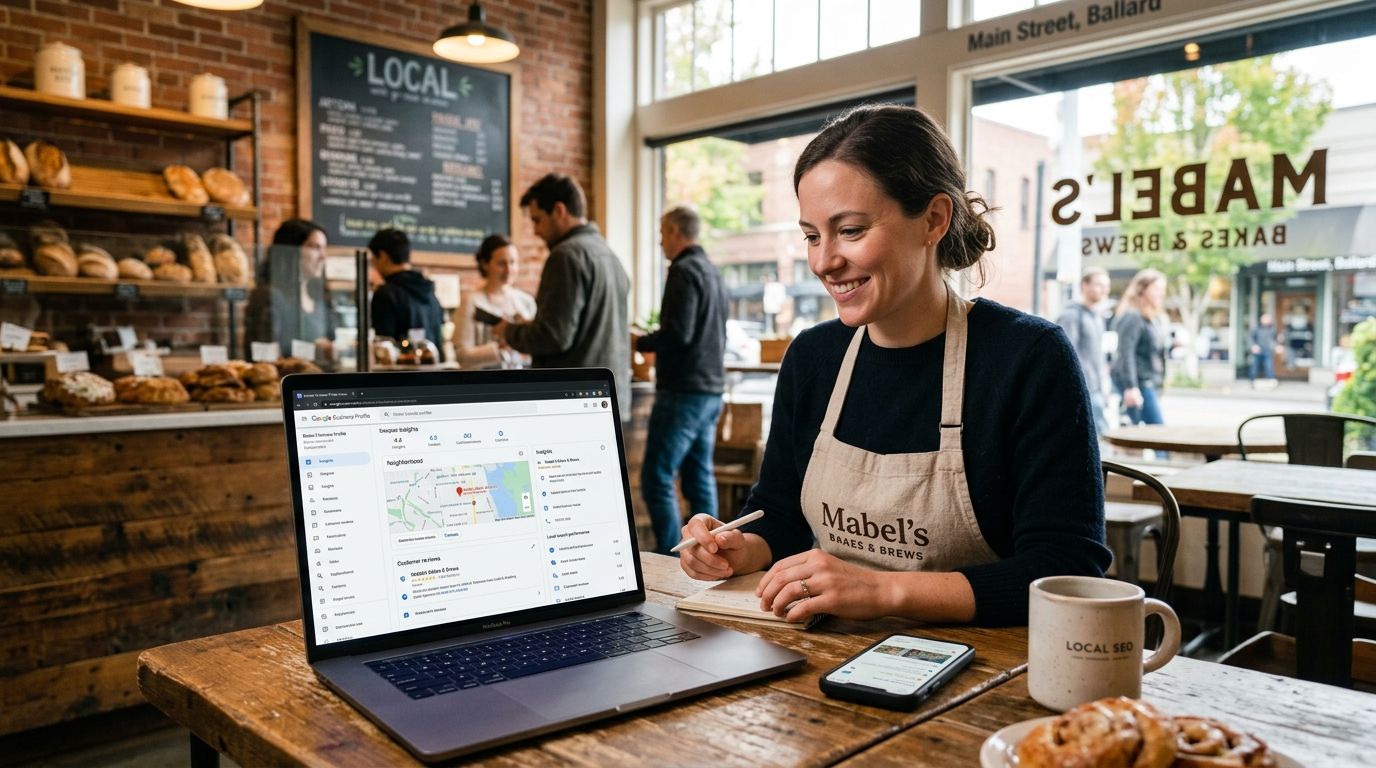
Google Business Profile optimization is the single highest-leverage local SEO fix available to a small business in 2026. It's free, it's fast to edit, and Google weighs it heavily because it's the primary data source for the map pack itself.
Fill in every category available — Google allows up to 10 categories per profile, one primary and nine additional, and leaving that field at just one category is leaving ranking signal on the table. Add real photos on a regular basis, keep hours accurate through holidays, and use the Q&A and posts features instead of ignoring them. A profile updated last quarter reads as stale to both Google and the searcher scrolling past it.
Local Citations and NAP Consistency
A citation is any online mention of your business name, address, and phone number — Yelp, Bing Places, industry directories, the local chamber site. When your phone number on one directory doesn't match the one on your website, Google treats that as a trust signal problem, not a typo.
Run through your top 15-20 citation sources and fix mismatches before you spend a dollar on link building. NAP consistency across directories does more for local ranking stability than a burst of new backlinks. A messy citation profile is the quiet reason a lot of otherwise solid local businesses stay stuck outside the map pack.
Reviews and Reputation Management
Google reviews use a 5-star scale, and both the average and the recency of reviews factor into local ranking. A business with 40 reviews from three years ago loses to a competitor with 15 reviews collected in the last two months — freshness beats volume here.
Respond to every review, including the negative ones. A calm, specific reply to a bad review signals to future customers — and to Google — that the business is actively managed. If review generation and response feels like a full-time job on top of everything else, reputation management for small business owners is built to carry that load.
Location Pages for Multi-Location Businesses
If you operate out of a single storefront, your Google Business Profile and homepage do most of the work. If you run more than one location, each one needs its own page with a unique address, phone number, and local content — not a single "locations" page listing five cities in a bulleted list.
Duplicate or thin location pages confuse Google about which page should rank for which city, and you end up competing against yourself instead of the competitor down the street. Local SEO for multi-location businesses covers the page structure that avoids that trap.
Local Link Building
Backlinks still matter for local SEO, but the sources matter more than the count. A single link from a local news site or chamber of commerce carries more weight than ten low-quality directory links.
Sponsor a local event, get listed in a regional business association directory, or pitch a local reporter on a story tied to your industry. Local link building works best as the last step, after the Google Business Profile and citations are already clean — links pointing at an incomplete profile don't move the needle much.
DIY vs. Agency-Managed Local SEO
Approach
Best for
Trade-off
DIY local SEO
Owners with a few hours a week and patience for the learning curve
Slower to compound, easy to fall behind on updates
Agency-managed local SEO
Owners who want steady month-over-month movement without doing the work themselves
Requires picking a vetted partner and a real budget commitment
Both paths work in 2026. The difference is speed and consistency, not whether the tactics themselves are different.
Why Local Rankings Vary
A handful of factors explain why two similar businesses in the same city rank differently for the same search:
Proximity to the searcher — Google factors in how close the business is to the person searching, and you can't change your address to fix this.
Review recency and volume — a steady drip of new 5-star and mixed reviews outperforms a stale five-star average from years ago.
Category completeness — profiles using fewer than the available 10 categories rank behind more thoroughly categorized competitors.
NAP consistency — mismatched phone numbers or addresses across directories erode trust signals.
Website relevance — a homepage that never mentions the service area by name gives Google less to match against local searches.
Engagement on the profile — photo uploads, posts, and Q&A activity signal an actively managed business.
How Long Does It Take to See Local SEO Results?
Local SEO tends to move faster than organic SEO because you're optimizing a Google Business Profile listing directly instead of waiting for domain authority to build over time. Fixing NAP mismatches and completing a profile can shift map pack visibility within weeks, while review-driven trust signals build more gradually as new reviews accumulate.
Is Local SEO Different from Regular SEO?
Local SEO is different from regular SEO because it's built around a physical location or service area rather than ranking a webpage nationally. Regular SEO competes for informational and commercial keywords across the entire web; local SEO competes for a spot in the 3-result map pack tied to a specific geography.
Do I Need a Website to Rank in the Local Map Pack?
You don't strictly need a website to appear in Google's local map pack, since the profile itself can rank on its own. A website still matters for everything the map pack doesn't cover — service detail, pricing context, and converting the click once someone finds you.
FAQ
How do I improve local SEO rankings for a small business in 2026?
Improve local SEO rankings by fully completing your Google Business Profile, fixing NAP mismatches across directories, and generating recent reviews before investing in backlinks. These three fixes address the majority of ranking gaps for small businesses in 2026.
How many Google reviews do I need to rank higher?
There’s no fixed review count that guarantees a higher rank — recency and response rate matter more than total volume. A business with 15 recent reviews often outranks one with 40 reviews collected years ago.
Does NAP consistency really affect local rankings?
Yes, inconsistent name, address, or phone number listings across directories create trust signal problems for Google. Fixing these mismatches is one of the fastest, lowest-cost ranking fixes available.
Is local SEO worth it for a service-area business without a storefront?
Yes, service-area businesses can still claim a Google Business Profile and rank in the local map pack without a public storefront address. The profile setup differs slightly, but the ranking factors — reviews, categories, consistency — apply the same way.
What’s the fastest way to improve local SEO rankings?
Completing every field on your Google Business Profile, including all 10 available categories, is the fastest single fix available. It costs nothing and Google weighs it heavily in map pack placement.
Is local SEO different from regular SEO?
Local SEO targets the 3-result map pack tied to a physical location or service area, while regular SEO competes for national organic rankings. The tactics overlap but the ranking signals are weighted differently.
Do I need a website to rank in Google’s local map pack?
No, a Google Business Profile can rank in the map pack on its own without a website. A website still helps convert the click once a searcher finds the listing.
One Last Thing
Google recalculates local rankings every time someone runs a search, not on a fixed monthly schedule — there's no ranking freeze to wait out. A business that goes quiet on reviews and profile updates for a few weeks can slide out of the map pack even if nothing about the business itself changed, which is the real reason "we set it up once" local SEO strategies stop working by mid-2026.
Need marketing and funding aligned?
Talk through local SEO priorities and how to budget for them.
Build a customer review generation strategy that grows Google reviews in 2026 with proven timing, automation, filtering and response tactics for small business.
Digital marketing for insurance agencies in 2026: local SEO, review, and renewal email steps that turn quote traffic into bound policies. See the full playbook.
Digital marketing for medical spas in 2026: which channels book patients first, common mistakes, and how to fund the first 90 days without cutting corners.
Local SEO for multi-location businesses in 2026: fix NAP, profiles, and reviews per location. Full audit steps, comparison table, and mistakes to avoid.
The 7 best marketing strategies for small business growth in 2026, ranked by cost, speed to results, and budget fit for teams that need measurable results.