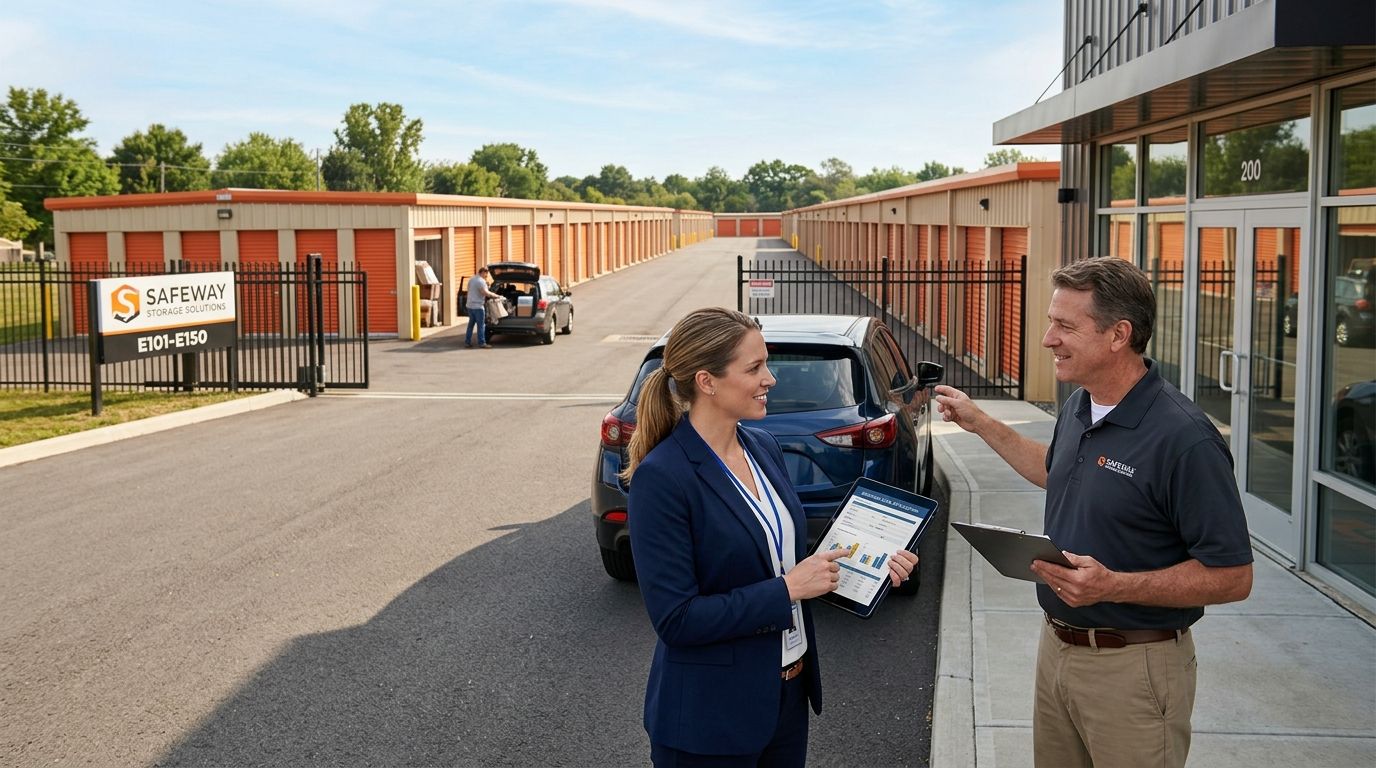
Business loans for self storage facilities are financing products sized around a property's occupancy rate, unit mix, and lease income, built to fund acquisition, construction, expansion, or refinancing without handing over equity. Self storage operators face a different underwriting picture than most small businesses — lenders look at rent-per-square-foot trends and climate-controlled unit demand instead of retail foot traffic or restaurant covers, which changes which loan products actually fit.
TL;DR
SBA 504 and 7(a) loans work best for self storage owners buying or building a facility outright in 2026.
Bridge loans cover lease-up gaps when a new facility isn’t yet at stabilized occupancy.
Business loans for self storage facilities hinge on rent roll and occupancy data, not just business credit.
A business line of credit fits ongoing maintenance and marketing spend better than a term loan does.
Trifecta Business Group matches self storage owners to the funding structure that fits their occupancy stage.
Why business loans for self storage facilities matter
Self storage is a real estate-backed business, which means the loan conversation starts with the asset, not just the P&L. A facility at 60% occupancy qualifies for very different financing than one at 90%, and owners who walk into a bank without that distinction mapped out get slower approvals or worse terms.
Lenders treat self storage as a niche commercial real estate category, and most conventional banks price it more conservatively than they price multifamily or office. That's why commercial real estate loans for business investors built specifically around income-producing property tend to outperform generic small business term loans for facility purchases and ground-up builds.
The stakes are higher than they look on paper. A construction loan that stalls mid-build because draw schedules weren't structured around unit completion phases can delay lease-up by months, and every month of delayed occupancy is rent that never gets collected.
Assess your facility's financial position first
Before approaching any lender, get a clear picture of where the property actually stands. Loan officers underwriting self storage assets ask for this data on day one, so having it ready shortens the whole process.
Pull trailing 12-month occupancy and rent-per-square-foot by unit type (climate-controlled vs. standard, drive-up vs. interior)
Calculate net operating income after property taxes, insurance, and management costs
Separate stabilized units from units still in lease-up
Document any planned expansion phases (additional buildings, conversion to climate-controlled)
Review personal and business credit scores for all guarantors
Match the loan type to your facility's stage
A newly constructed facility at 40% occupancy needs a different loan than a stabilized 15-year-old property generating consistent cash flow. Matching structure to stage is where most self storage owners either save or waste real money.
Acquisition of an existing, stabilized facility: conventional CRE loan or SBA 504
Ground-up construction or expansion: SBA 504 or a construction-to-permanent loan
Lease-up gap on a newly built facility: a bridge loan while occupancy climbs toward stabilization
Refinance to pull equity for a second location: cash-out refinance against the stabilized asset
Day-to-day repairs, gate systems, or marketing: a revolving line of credit rather than a term loan
Understand SBA options before you rule them out
SBA loans get dismissed by self storage owners who assume the program only fits retail storefronts or restaurants, but the SBA loans for small business owners program covers owner-occupied commercial real estate, and self storage facilities qualify when the operating business occupies and manages the property.
SBA 504 loans are structured for major fixed-asset purchases like land, buildings, and ground-up construction
SBA 7(a) loans work for a combined purchase-plus-working-capital request
Both programs carry longer amortization schedules than conventional bank loans, which lowers monthly debt service
Personal guarantees and a detailed business plan are required for both programs
Prepare documentation lenders actually ask for
Self storage underwriting is document-heavy because the lender is really underwriting the real estate. Skipping ahead here is the single biggest cause of stalled applications in 2026.
Rent roll with unit-by-unit occupancy and rate history
Trailing profit and loss statements for the property, not just the parent business
Appraisal or broker opinion of value if available
Site plan and zoning confirmation for any planned expansion
Personal financial statements for all guarantors above 20% ownership
Owners who want a structured walkthrough before submitting anything can use how to prepare your business for a funding application as a pre-submission checklist rather than learning gaps the hard way through a declined application.
Compare lenders across structure, not just rate
Rate matters less than most owners assume when a facility is still stabilizing. Amortization length, draw schedule flexibility, and prepayment terms often swing total cost more than a point or two of interest.
Community and regional banks tend to know local self storage supply better than national lenders
Credit unions sometimes offer more flexible personal guarantee terms for smaller loan amounts
SBA-preferred lenders process 504 and 7(a) applications faster than non-preferred lenders
Bridge lenders price higher but move faster when a construction loan needs to convert to permanent financing on a tight timeline
Build credit and cash reserves before you need them
The strongest position for any self storage loan application is one built months in advance, not the week before a purchase agreement expires. Lenders reward a track record of on-time debt service and clean business credit far more than a compelling pitch.
Keep business credit utilization low on any existing revolving accounts
Maintain three to six months of debt service in reserve before applying
Resolve any liens or judgments tied to prior properties before submitting
Negotiate terms instead of accepting the first offer
Self storage loans have more negotiating room on prepayment penalties and draw schedules than most owners realize. Interest rate is the easiest number to compare, which is exactly why lenders concede less on it and more on structure.
Compare financing options for self storage facilities
Loan Type
Best For
Key Limitation
SBA 504 loan
Ground-up construction or major facility purchase
Slower approval timeline than conventional bank debt
SBA 7(a) loan
Purchase plus working capital in one package
Loan caps limit use for very large acquisitions
Conventional CRE loan
Stabilized, income-producing facilities
Requires strong occupancy history to qualify
Bridge loan
Facilities still in lease-up
Higher cost until the property stabilizes and refinances
Business line of credit
Repairs, marketing, and seasonal cash gaps
Not built to fund a full acquisition or build
Verdict: SBA 504 wins for owners buying or building a facility outright, a bridge loan wins for anyone still filling units, and a business line of credit wins for the ongoing cash needs neither of the other two is designed to cover.
Applying before occupancy data is organized. A rent roll pulled together the night before a lender call reads as disorganized, and self storage underwriting lives or dies on that document.
Treating construction loans and permanent loans as interchangeable. A construction loan that isn't paired with a clear takeout plan leaves owners scrambling once the building is finished.
Ignoring bridge financing during lease-up. Owners who try to force a conventional loan onto a facility still climbing toward stabilized occupancy get declined or repriced.
Comparing lenders on rate alone. Prepayment penalties and draw schedule flexibility often cost more over the life of the loan than a fractional rate difference.
Waiting until a purchase agreement is signed to think about credit. Business credit and reserve requirements take months to shore up, not days.
FAQ
What is the best business loan for buying a self storage facility?
An SBA 504 loan is the strongest fit in 2026 for owners purchasing or constructing a self storage facility outright, since it’s built for major fixed-asset purchases with longer amortization than conventional bank debt. A conventional commercial real estate loan works well too if the facility already has strong, stabilized occupancy.
Can a new self storage facility get financing before it’s fully leased up?
Yes, a bridge loan is designed exactly for this gap, covering the facility while occupancy climbs toward a stabilized level. Once occupancy and rent roll data support it, the bridge loan typically converts into permanent, lower-cost financing.
Do SBA loans cover self storage facilities?
SBA 504 and 7(a) loans both cover self storage when the operating business occupies and manages the property, not just a leased-out passive investment. The 504 program fits large fixed-asset purchases and ground-up construction specifically.
How does occupancy rate affect loan qualification for self storage?
Occupancy rate is one of the first numbers a lender pulls, because it directly drives the net operating income the loan gets sized against. A facility below stabilized occupancy usually needs bridge financing rather than a conventional term loan.
What documents do lenders need for a self storage business loan?
Expect to provide a unit-by-unit rent roll, trailing profit and loss statements for the property, personal financial statements for guarantors, and site plans for any planned expansion. Missing any one of these typically slows down underwriting the most.
Is a business line of credit useful for a self storage facility?
A business line of credit works well for ongoing costs like repairs, gate system upgrades, and marketing spend, but it isn’t structured to fund an acquisition or a full build. Pair it with a term loan or SBA loan for larger capital needs.
How long does it take to get approved for a self storage business loan?
SBA loans generally take longer to close than conventional bank debt because of the additional documentation requirements, while bridge loans move faster when a deal has a tight closing timeline. Having occupancy and financial documentation ready ahead of time is the biggest factor in speeding this up.
One last thing
The owners who get the best terms in 2026 aren't the ones with the highest occupancy — they're the ones who can explain exactly why occupancy sits where it does, whether that's a new competitor two miles away or a planned climate-controlled conversion already underway. Lenders underwrite the story behind the number just as much as the number itself, and self storage owners who show up with both close faster and negotiate from a stronger position.
Business loans for bakeries in 2026: SBA loans, equipment financing, lines of credit, and cash advances compared, with a step-by-step guide to qualifying.
Funding solutions for assisted living facilities in 2026: SBA loans, real estate financing, and working capital lines matched to occupancy and payer mix.
A business line of credit for small business owners revolves, not a lump sum. See 2026 criteria, top-fit scenarios, and what to avoid before you apply.
Business loans for photography studios in 2026: equipment financing, working capital, and SBA options matched to seasonal booking cycles and slow-month cash gaps.
Compare the best unsecured business loans for 2026 — term loans, lines of credit, SBA 7(a), MCA, and factoring, ranked by use case with clear pros and cons.