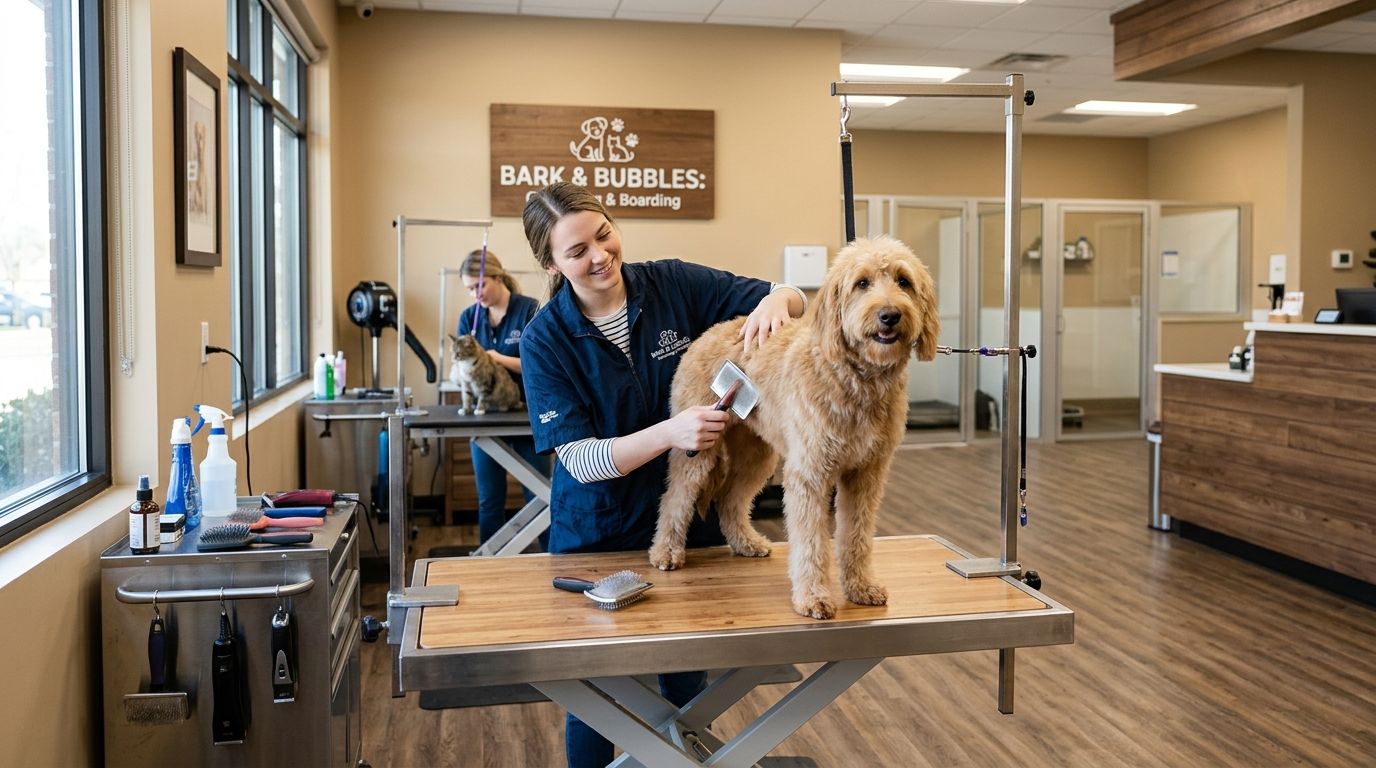
Pet grooming and boarding business loans are financing tools built to cover the equipment, facility upgrades, staffing, and cash flow gaps that come with running an animal care business — the goal is keeping cages full, groomers booked, and payroll covered through the slow months. A grooming salon and a boarding kennel have different capital needs than a typical retail shop: bathing stations, drying systems, HVAC built for animal odor and dander control, kennel banks, and outdoor runs all cost more than standard buildout, and demand swings hard around holidays and travel seasons.
TL;DR
Business loans for pet grooming and boarding cover equipment, facility buildout, and seasonal cash flow gaps — SBA loans and equipment financing fit best for most owners in 2026.
A business line of credit outperforms a term loan for boarding kennels with sharp seasonal swings around holidays.
Lenders want 1-2 years in business, consistent bank deposits, and a debt schedule before approving grooming or boarding financing.
Merchant cash advances close fastest but cost the most — reserve them for true emergencies, not routine growth.
Why funding matters for pet grooming and boarding businesses
Grooming and boarding operate on thin, predictable margins that get disrupted by two things: equipment failure and seasonal demand swings. A broken dryer system or a dead HVAC unit in a kennel isn't a maybe-later repair — it's a same-week problem that affects animal safety and forces closures. At the same time, boarding facilities often see 30-40% of annual revenue concentrated around major holidays, which means January and February cash flow can look nothing like December's.
That combination — high-cost equipment plus lumpy revenue — is exactly what most generic small business loan advice ignores. A salon and spa business loan faces a similar service-business funding profile: appointment-based revenue, facility-dependent operations, and equipment that needs replacing on a schedule, not on impulse. The lending criteria overlap more than owners expect.
Map your funding need to the actual expense
Before you talk to any lender, separate what you're actually financing. Equipment, real estate, and working capital are different loan categories with different terms, and mixing them up wastes weeks.
List every planned expense by category: equipment, buildout/renovation, payroll, marketing, inventory (shampoo, food, retail products)
Attach a dollar figure to each, even a rough one
Flag which expenses are one-time versus recurring
Decide whether the need is growth-driven (new location, more kennels) or gap-driven (slow month payroll)
Separate anything tied to a specific piece of equipment from general operating cash needs
Gather your financial documentation
Lenders evaluating a grooming or boarding business want to see stability, not just revenue size. Most will ask for the same core package regardless of loan type.
Twelve months of business bank statements
Two years of business tax returns, three if you're pursuing an SBA loan
A current profit and loss statement and balance sheet
A debt schedule listing every existing loan, line of credit, or advance
Your business license and any pet care certifications or permits tied to the business
Check your eligibility before you apply
Applying blind to multiple lenders wastes time and can ding your credit with unnecessary inquiries. Do the math yourself first.
Confirm at least 1-2 years in business — most term lenders and SBA programs require this minimum
Check your personal credit score; 650+ opens more doors, though not every product requires it
Calculate your average monthly deposits over the last 6 months
Review whether you're current on existing debt — one missed payment can disqualify you from bank-tier rates
Compare loan types built for your equipment and facility needs
Grooming tables, tubs, dryers, and kennel banks are capital-intensive, and financing them the wrong way ties up cash you need elsewhere.
Equipment financing uses the equipment itself as collateral, which usually means better rates than unsecured products
SBA 7(a) loans cover both equipment and buildout in one package for businesses that qualify
Term loans work for a single large project with a defined payback timeline
A business line of credit is better suited to recurring, unpredictable repair needs than a lump-sum loan
Equipment financing structured around the useful life of grooming or HVAC equipment avoids paying off a dryer long after it's been replaced
Time your application around your slow season
Applying for financing during your slowest cash flow month is the single most common mistake grooming and boarding owners make, because lenders read low deposits as risk, not seasonality.
Apply 60-90 days before your peak season, not during your trough
If revenue is genuinely seasonal, disclose it upfront with 12+ months of statements so the pattern is visible, not hidden
Structure repayment to scale with revenue where the lender allows it
Keep a cash buffer of at least one slow month's operating costs before you commit to new fixed payments
Negotiate terms that match your cash flow pattern
A loan that fits your business on paper can still strangle you month to month if the repayment structure doesn't match how revenue actually arrives.
Ask for seasonal or step-up payment structures if your lender offers them
Compare total cost of capital, not just the monthly payment — a lower payment stretched over more months can cost more overall
Negotiate prepayment terms in case a strong season lets you pay down early
Confirm whether the rate is fixed or variable before signing
Build business credit for better long-term terms
Every grooming and boarding business eventually needs a second round of financing — a new location, a fleet of mobile grooming vans, a bigger kennel bank. The terms on that second loan depend on what you build now.
Open a business credit card and keep utilization under 30%
Pay vendors (grooming supply distributors, food suppliers) on terms that report to business credit bureaus
Keep personal and business finances fully separated
Review your business credit report annually for errors
Comparing funding options for grooming and boarding businesses
Option
Best For
Key Limitation
SBA 7(a) loan
Facility buildout or multi-location expansion
Slower approval, heavier documentation
Equipment financing
Grooming tables, dryers, HVAC, kennel systems
Only covers the specific equipment financed
Business line of credit
Recurring repairs and seasonal cash gaps
Requires discipline to avoid over-drawing
Term loan
One large, defined project
Fixed payments regardless of seasonal revenue
Merchant cash advance
Emergency same-week cash needs
Highest cost of capital of the group
A grooming business replacing a failed dryer system this month needs equipment financing, not a merchant cash advance — the collateral changes the math entirely.
Common mistakes pet grooming and boarding owners make
Financing equipment with unsecured working capital — paying dramatically more in interest for collateral-eligible purchases
Ignoring seasonality when structuring repayment — accepting flat monthly payments that assume December-level revenue in February
Underestimating buildout costs for ventilation and drainage — animal care facilities have code requirements retail spaces don't
Applying to one lender only — missing better rates available through SBA or equipment-specific programs
Treating a merchant cash advance as routine financing — using the fastest, most expensive option for needs that could wait 2-3 weeks for cheaper capital
Get funding built for your grooming or boarding business
Talk through equipment, buildout, or working capital options before you apply anywhere else.
What’s the best business loan for a pet grooming business in 2026?
Equipment financing is the best fit when the need is a grooming table, dryer, or HVAC system, since the equipment secures the loan and typically lowers the rate. For facility buildout or expansion, an SBA 7(a) loan covers a larger project in one package.
Can a boarding kennel get a loan with seasonal revenue?
Yes, but the application should disclose the seasonal pattern upfront with 12 months of bank statements rather than let a lender discover low winter deposits on their own. Working capital products built for seasonal businesses handle this pattern better than a flat-payment term loan.
Is a business line of credit better than a term loan for a grooming salon?
A line of credit works better for recurring, unpredictable repair needs since you only draw and pay interest on what you use. A term loan fits a single large, defined project like a full facility renovation.
How much documentation does a pet care business need for an SBA loan?
Expect to provide three years of business tax returns, a current profit and loss statement, a balance sheet, a full debt schedule, and business licensing or pet care permits. SBA loans require heavier documentation than a standard term loan or line of credit.
How long does it take to get equipment financing for grooming equipment?
Equipment financing generally moves faster than SBA loans because the equipment itself acts as collateral, reducing underwriting complexity. Exact timelines vary by lender and documentation completeness.
Should a new boarding facility use a merchant cash advance to open?
A merchant cash advance is the highest-cost option in the comparison and works best for true emergencies, not startup buildout. New facilities are better served by an SBA loan or equipment financing matched to the specific buildout cost.
What credit score does a grooming business need to qualify for financing?
A personal credit score of 650 or higher opens access to more competitive term loans and SBA products, though some equipment financing and working capital products accept lower scores. The stronger the score, the better the rate offered.
Can a mobile pet grooming business get equipment financing for a van?
Yes, mobile grooming vans and the equipment inside them are financeable through equipment financing, which uses the van and installed equipment as collateral. This structure typically beats financing the purchase through unsecured working capital.
One last thing
Boarding facilities with sharp holiday demand almost always over-index on term loans when a business line of credit fits their cash flow shape better — a line lets you draw for a slow-month payroll gap in February without carrying a fixed payment through a strong December. Match the product to the pattern, not the other way around.
Accounts receivable financing for B2B companies in 2026: advance rates, recourse vs non-recourse, steps to qualify, and mistakes that slow down funding.
Compare SBA, bridge, and CRE loans for self storage facilities in 2026. See which structure fits your occupancy stage and how Trifecta Business Group can help.
Business loans for bakeries in 2026: SBA loans, equipment financing, lines of credit, and cash advances compared, with a step-by-step guide to qualifying.
Business funding for veteran-owned businesses in 2026: franchise, trucking, and construction funding compared, with a clear Buy or Skip verdict on each option.
Funding solutions for solar installation companies in 2026: equipment financing, working capital, and credit lines matched to the 60-90 day install-to-payout gap.